New public work since Digest #3. Short notes here, the detail at the links.
Three new teardowns. OpenHarness is a command centre that runs Claude Code, Codex and other agents in tmux panes. The part worth copying is how it bounds a claim by what ran. Its validation receipt binds the commit, the tree and a hash of the uncommitted diff, because a commit SHA on its own would pass off a dirty checkout as tested. The gap is that pull-request CI was switched off, so the receipt is voluntary. Zenith gives the decision to stop to a closing reviewer that sees only the original request. Before adopting that I ran it on fifteen of my own finished tasks. It found two real misses in five build, patch and prose tasks and none in ten experiment tasks, so it's on trial for the first kind only. Superpowers writes no rule until a control run with no guidance shows the failure, and it keeps its failed cost experiments on the record. Nothing in its tree runs its 66 test files.
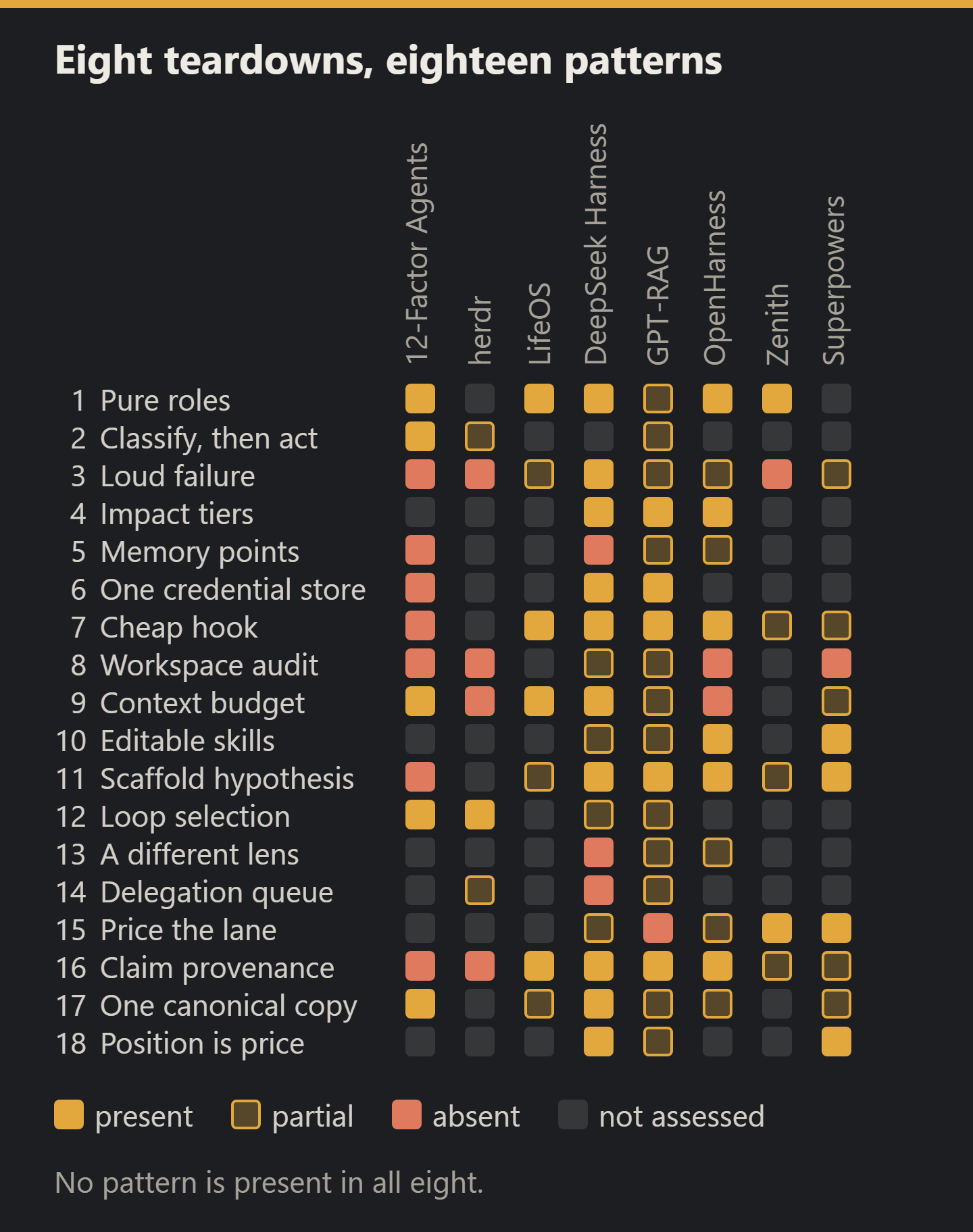
The eight teardowns side by side. The teardown index now sets eight subjects against the eighteen patterns, and 54 of its 144 cells are marked not assessed, because a reading that didn't look for a pattern is no evidence it's missing. No pattern is present in all eight. The dead man's switch is the cheapest control in the set and was assessed in every reading. It's absent from three of them, and a fourth has written one and left it unscheduled.
One teardown rewritten and two citations corrected. The first version of the LifeOS teardown read the README and missed the install payload, where most of the system lives, so all four of its absence claims were wrong or overstated. The page is rewritten against the full payload at the same revision. Pattern 10 credited a collapse figure, 0.554 to 0.026, to the SkillOpt paper. A maintainer who had read the paper pointed out that it isn't in there, and the line now cites the repo's own results file. A line on memory staleness and drift cited a paper that doesn't make the distinction, so it's now stated as the workspace's own claim. Every teardown gets a search of the whole tree at the pinned revision before it calls anything absent.
Six experiments, published with their null results. The new experiments section has six write-ups of tests the workspace ran on itself, each registered before its data was read. Two came back null. Compacting at task boundaries left the median bill 2.2% higher, and tool-output reuse missed its bar at 21.0% against 25%. One overturns something Digest #3 reported. The cache keep-alive priced at break-even, so it has been cut and Pattern 18 records it as tried and cut.
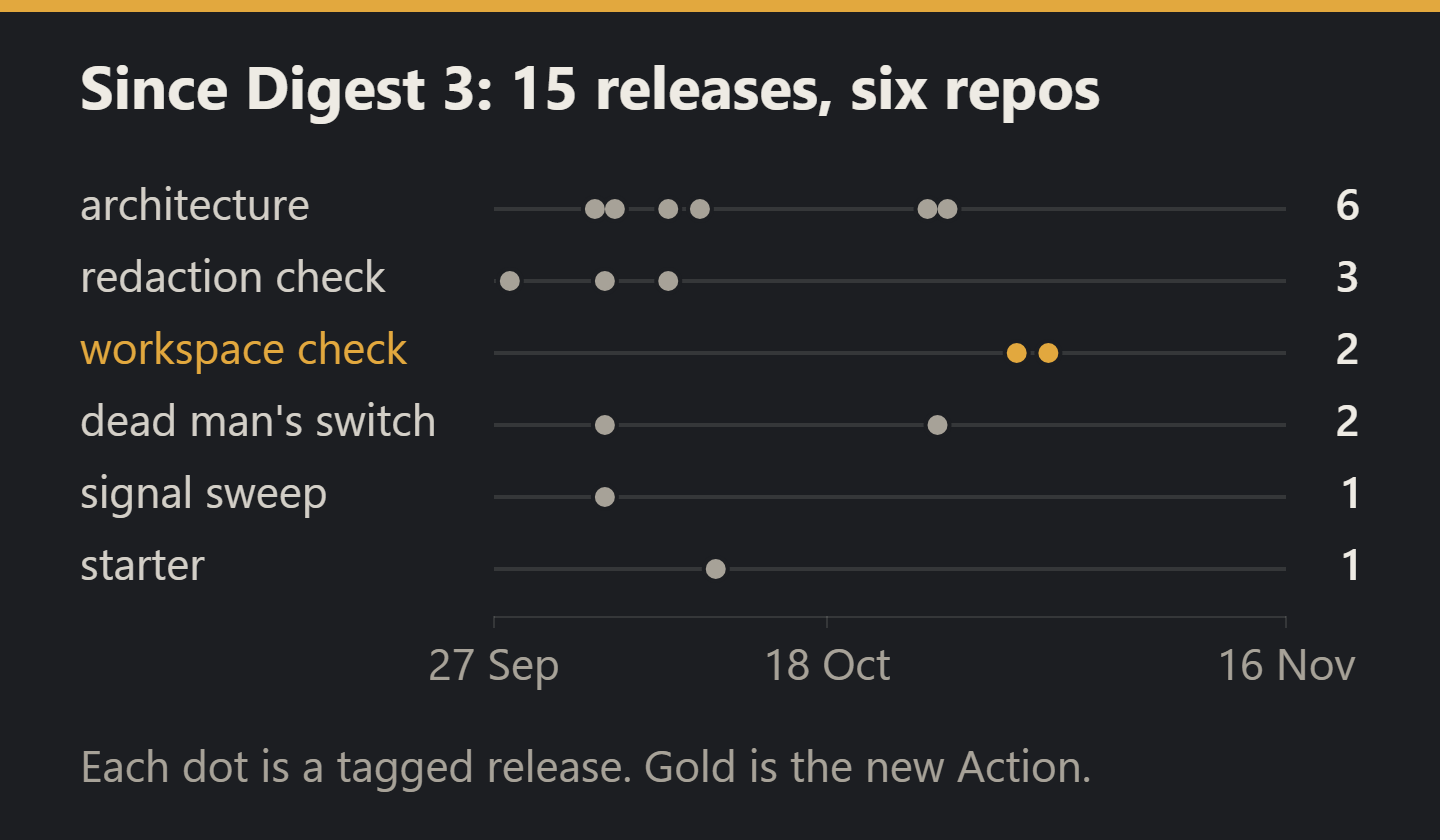
A new Action that runs the workspace check in CI. workspace-check-action runs the read-only linter in CI and puts a score out of 10, its band and a badge in the job summary. It has twelve checks, runs no model, makes no network call and writes nothing to the tree. Version 1.1.0 reads AGENTS.md and reports N/A for a check that scanned nothing, which moves scores both ways. An empty directory used to score 6.4 and now scores 3.8.
Guards that fail closed. The Pattern 7 samples now name the interpreter by full path and set each guard to block the call when it can't start. The starter's shell guard was missing more than its README claimed. Commands sitting behind shell keywords or inside braces were never examined, and both gaps are fixed in v0.2.0. dead-mans-switch 0.3.1 fixes a stray log name with a future date that could hold a dead job at FRESH. redaction-check-action 1.1.1 reports the current OpenAI key shapes, which the old pattern let through.
Four additions to awesome-agent-workspaces. Tale reuses each project agent's sandbox across tasks and keeps the deliverables for human review. OpenViking keeps an agent's memory, knowledge and skills in one virtual filesystem, with abstract and overview tiers per directory so context can load at more than one level of detail. Screenpipe keeps locally captured screen text and audio transcripts searchable through MCP. TreeHarbor keeps coding-agent patches tied to their starting Git commit, ready for export after the workspace is cleaned up. One submission was declined, with the reason on the record in the list's rejections file.
One new essay. The understanding was a by-product of the doing is about what happens to the people checking AI output. Lisanne Bainbridge described the mechanism in 1983, and later research found that training doesn't prevent it.
A second read on your workspace. There's a new Second read category in the repo's Discussions. Post a public repo and the commit you want read, and the reply carries the linter score, three strengths and three gaps.
Same invitation as before. If a teardown misread something, reply, and the correction goes on the page with a date.