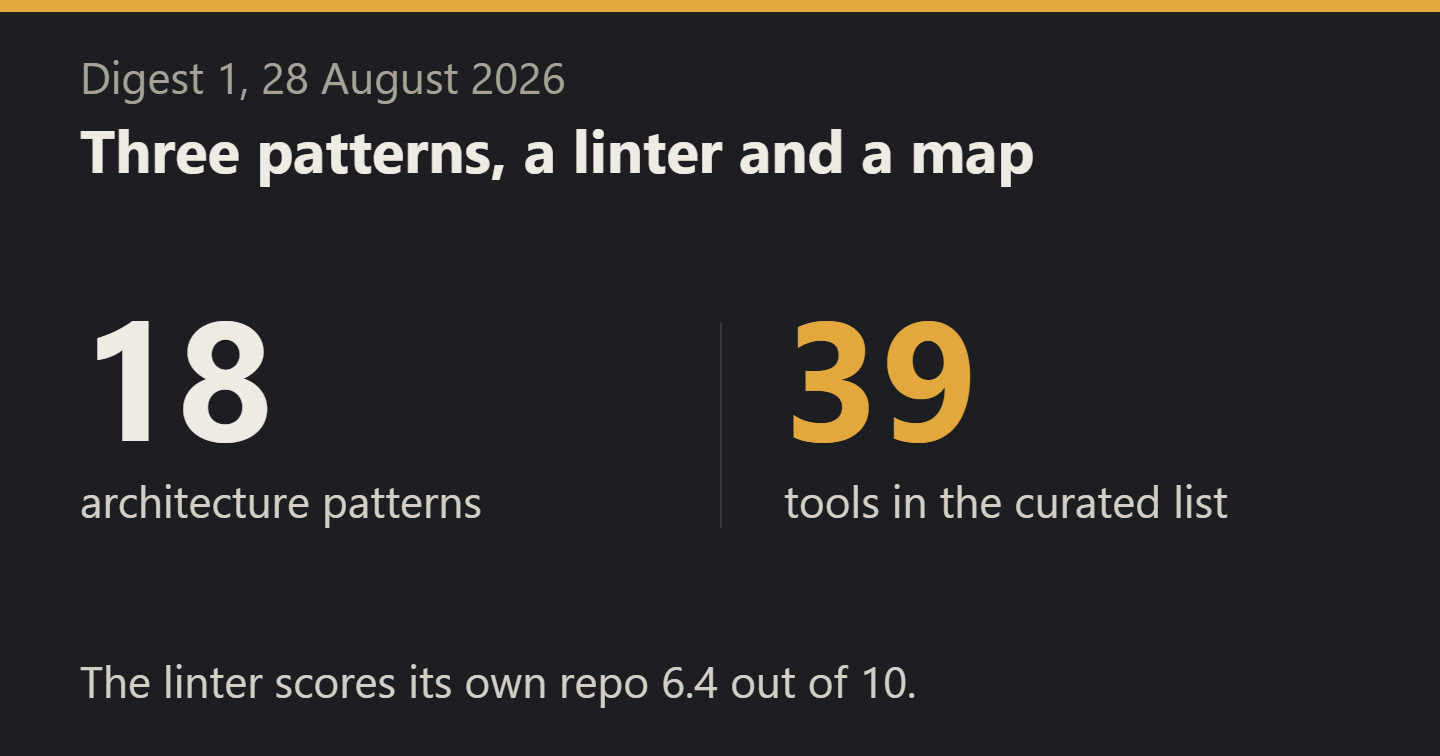
This is the digest lane of Agent Workspaces: an occasional roundup of new public work, with short notes on what matters and why. The full work lives at the links. First issue, so it covers the last fortnight.
Three new patterns in the reference architecture. PATTERNS.md now runs to eighteen.
- Pattern 16, A claim carries its provenance, or it is a guess. After months of watching agents assert workspace state from memory, this is the rule that stuck. Read the source and cite the line, or tag it unverified.
- Pattern 17, One canonical copy, and pointers from everywhere else. I wrote this one about ninety minutes before breaking it myself, building a duplicate of a tool that already existed. The pattern page carries the worked failure.
- Pattern 18, Position is price. A token's cost is its size times every turn that follows it. The same 104k-token read cost 147 times more at turn 3 than at turn 182 of one measured session. Where you put context matters more than how much you have.
The evaluation method is written up. EVALUATION.md is how I tell whether a workspace change actually helped: cases frozen from real recorded failures, replayed five times, reported as a pass rate with variance. Deterministic checks only, never an LLM judge, because the instrument exists to detect regression and a judge adds its own noise. The harness and three sample cases ship in the repo.
A linter you can run on your own workspace. workspace_check.py is one stdlib file with twelve checks against the mechanically checkable patterns, one evidence line each, and a 0 to 10 score. No network, no telemetry, nothing executed from your tree. Run against its own repo it scores 6.4, which is the honest answer for a documentation mirror. If a check is wrong about your setup, I want to hear it.
A map of the ecosystem. awesome-agent-workspaces is a curated list of 39 tools and resources for durable agent workspaces. Every entry verified before listing, a stated inclusion bar, and a public rejection log. Submissions welcome. The bar is the product.
Also shipped: signal-sweep grew a response_sweep module that watches the threads you have already answered for replies, so a follow-up question never sits unread for two months again. First run against my own ledger found 37 of them. Lesson absorbed.
If these are problems you own rather than tools you build with, the Essays section is where I argue the consequences. Or just reply. I read everything.